






CPR Without Gravity: How Astronauts Save Lives in Space
The Fragile Reality of Space Emergencies
Space travel is often framed as the ultimate triumph of human engineering — gleaming spacecraft, astronauts in high-tech suits, and breathtaking views of Earth from orbit. But beyond the poetic imagery lies a stark reality: astronauts are still human. They get sick, they suffer injuries, and yes, they can face sudden cardiac arrest.
On Earth, cardiopulmonary resuscitation (CPR) is straightforward. You kneel, place your hands on the chest, and use the floor as leverage to deliver compressions. Gravity and body weight do half the job. But in space? There’s no “down.” There’s no floor to press against. Without gravity, even a simple chest compression becomes a physics problem.
That raises a haunting but necessary question: if an astronaut’s heart stops, how do you save them?
Why Cardiac Arrest in Space Is a Unique Threat
Astronauts undergo some of the most rigorous health screenings imaginable. Space agencies like NASA, ESA, and ISRO want only the fittest humans on missions. But long-duration stays in orbit or deep space exploration (like future Mars missions) increase health risks:
-
Fluid shifts: In microgravity, blood and fluids redistribute, often causing swelling in the upper body and strain on the heart.
-
Radiation exposure: Space radiation can subtly damage cardiovascular systems over time.
-
Stress and isolation: Mental and physical stressors increase overall risk.
-
Limited medical resources: Unlike Earth, where emergency crews arrive in minutes, astronauts are stuck with only what’s on board.
Cardiac arrest may be rare in space, but it isn’t impossible. And when every second matters, astronauts need a way to perform CPR — even while floating.
The Challenge: CPR Without Gravity
On Earth, you push down on the chest with your body weight. Each compression forces blood through the heart and brain. In microgravity, however:
-
There’s no body weight.
-
Astronauts and patients are both floating.
-
Without a stable surface, pushing on the chest may just push the rescuer away.
Imagine trying to do CPR on someone while both of you are inside a swimming pool, suspended mid-water — every push propels you backward instead of compressing the chest. That’s the astronaut’s dilemma.
Space CPR: Techniques Developed for Microgravity
Over decades, space agencies have tested and refined CPR techniques designed for life without gravity. The most promising ones are:
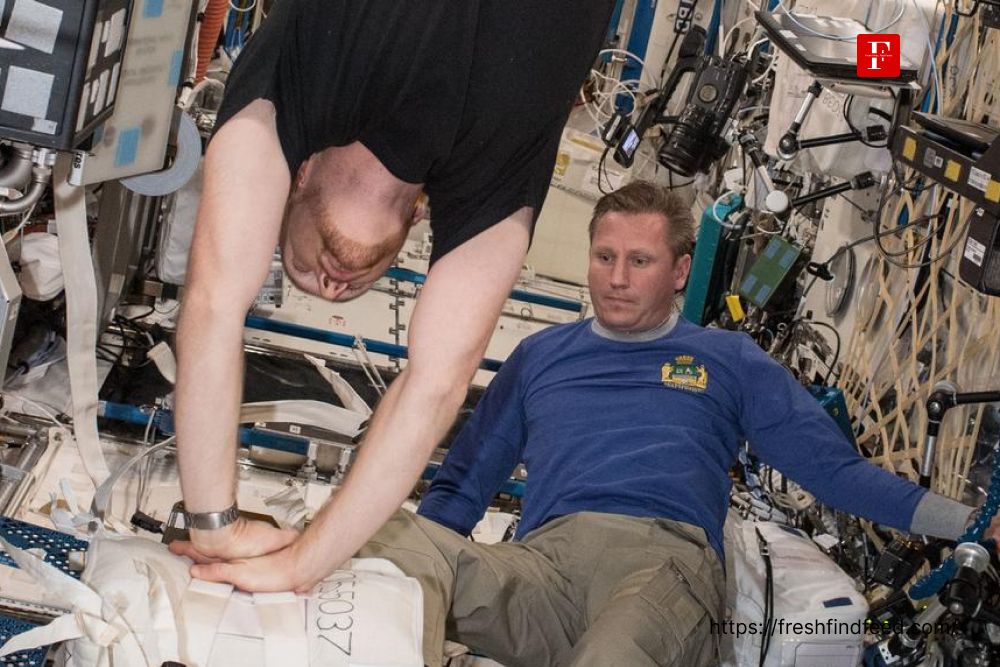
1. The Handstand Method (Evetts-Russomano Method)
In this technique, the rescuer places their feet on the cabin wall and leans forward, pressing into the patient’s chest with their arms. By bracing against the wall, they can generate compressions without floating away.
-
Pros: Stable, powerful compressions.
-
Cons: Only works if a wall is nearby and accessible.
2. The Reverse Bear Hug
Here, the rescuer floats behind the patient, wraps their arms around the chest, and squeezes rhythmically, much like giving the Heimlich maneuver in reverse.
-
Pros: Doesn’t require walls or tools.
-
Cons: Difficult to maintain proper rhythm and depth.
3. The Straddling Technique
The rescuer straps the patient to a surface, then straddles their torso and performs compressions using their arms. Straps provide some stability, reducing floating.
-
Pros: Mimics Earth-like CPR.
-
Cons: Requires preparation and equipment.
4. Foot Restraint Method
The rescuer locks their feet into a floor-mounted restraint and hovers over the patient. Using anchored legs, they push down with both hands.
-
Pros: Strong compressions, good leverage.
-
Cons: Time-consuming setup, not always possible in emergencies.
5. Automated CPR Devices
NASA and other agencies have tested compact mechanical CPR devices that strap onto the patient’s chest and deliver compressions automatically. These remove human strength and stability issues, but equipment size and weight are limiting factors for spacecraft.
Training Astronauts for Medical Emergencies
Astronauts already train extensively in neutral buoyancy pools, simulating weightlessness. They also use parabolic flights (nicknamed “vomit comets”) that provide short bursts of microgravity. During these sessions, they practice various CPR techniques on mannequins.
The goal isn’t just to practice mechanics — it’s to ensure astronauts can quickly choose the right method depending on where they are in the spacecraft and what equipment is available.
For long-duration missions, like those planned to Mars, astronauts may even include crew members trained as physicians. Space medicine is becoming a discipline of its own.
Ethical Dilemmas: When Saving a Life May Endanger the Mission
Here’s where things get tricky. CPR is exhausting, even on Earth. In space, it’s doubly draining because astronauts have to stabilize themselves while pushing. A rescuer could easily tire out before completing several minutes of compressions.
Moreover, CPR success rates depend on rapid access to defibrillators and post-resuscitation care. In orbit, there’s no hospital. If revival isn’t quick, the outcome is often grim.
This raises painful ethical questions:
-
Should astronauts attempt prolonged CPR if chances of survival are near zero?
-
Could continuing resuscitation compromise the health of the rest of the crew?
-
What protocols should dictate when to stop?
Agencies like NASA are working with bioethicists to establish guidelines, balancing human compassion with mission survival.
Future of Space Medicine: Beyond CPR
The CPR problem is just one piece of a bigger puzzle: how to handle all medical emergencies in space. Some futuristic solutions under study include:
-
AI medical assistants to guide astronauts step-by-step.
-
3D-printed medical tools for on-demand healthcare supplies.
-
Miniaturized robotic surgeons that could perform life-saving procedures.
-
Longer-lasting automated CPR machines adapted for space missions.
As humanity prepares for Moon bases and Mars colonies, medical readiness will be as critical as rocket fuel.
Earth Lessons From Space CPR
Interestingly, space CPR research has also helped on Earth. For example, techniques designed for microgravity have inspired methods for performing CPR in confined or unusual environments — such as submarines, airplanes, and disaster zones where lying a patient flat isn’t possible.
The “reverse bear hug” approach, for instance, has been tested in mountain rescues where terrain makes traditional CPR impossible. Space research is already improving survival chances here at home.
Conclusion: Saving Hearts Beyond Earth
Astronauts embody the spirit of exploration — but exploration is risky. As missions push further into deep space, medical preparedness becomes not just a support system but a survival necessity. CPR in microgravity is more than a technical challenge; it’s a reminder of human fragility and ingenuity.
Whether bracing against a spacecraft wall or using future AI-guided devices, astronauts are learning to keep hearts beating in the most hostile environment imaginable. Because out there, in the vast silence of space, every heartbeat truly matters.

You Might Also Like
-
The Reserve Bank of India (RBI) has appointed Sanjay Kumar Hansda and Sonali Sen Gupta as its new Executive Directors (EDs), a key leadership posit...
-
We live in a world where our phones, smart devices, and AI assistants are practically extensions of our minds. But have you ever wondered what all ...


Suggested Video