





Why History Keeps Repeating Itself – The Cycle Theory Explained
Introduction
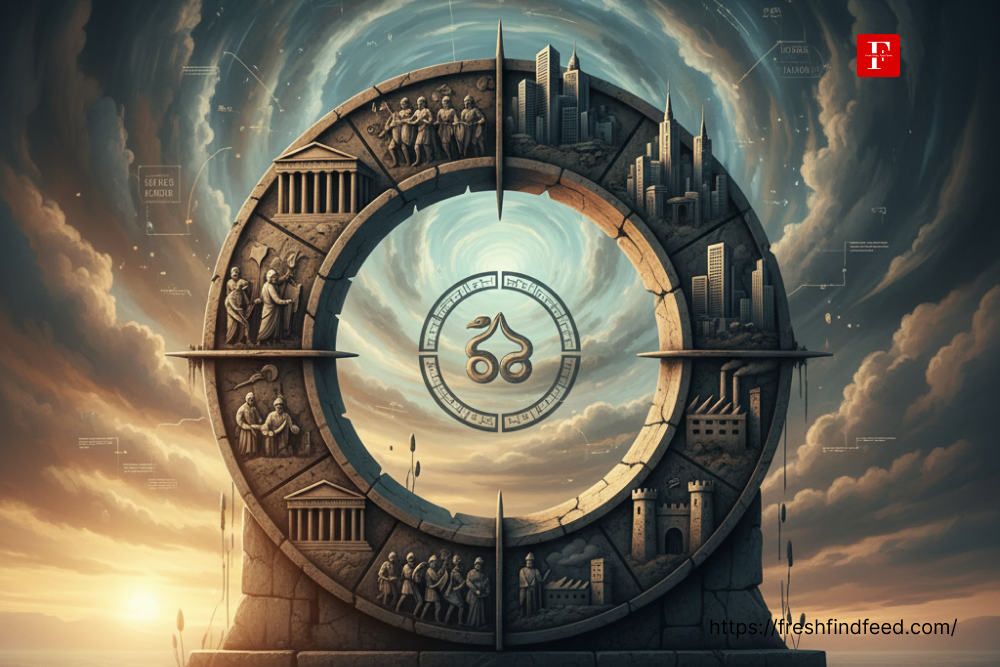
Every time a financial crash, a war, or a cultural revolution unfolds, we often hear the phrase: “History repeats itself.” But is this just a poetic observation—or is there a deeper truth hidden in the cycles of time? The Cycle Theory of History suggests that human societies don’t just move forward in a straight line. Instead, they rise and fall in repeating patterns, much like the changing of seasons.
From the rise and decline of empires to the boom-and-bust nature of economies, cycle theory argues that the past sets the stage for the future. But why does this keep happening, and what does it mean for us today?
Let’s dive into the fascinating world of historical cycles.
The Foundations of Cycle Theory
Historians and philosophers for centuries have debated whether history has a direction. Some believe it’s linear—progressing towards a better world through innovation and learning. Others believe it’s cyclical, where prosperity and decline are inevitable, repeating endlessly like the phases of the moon.
Key Thinkers Who Shaped the Idea
-
Ibn Khaldun (14th century): An Arab historian who argued that dynasties follow a predictable cycle of rise, consolidation, and fall.
-
Giambattista Vico (18th century): Proposed that history follows recurring cycles of growth and decay.
-
Oswald Spengler & Arnold Toynbee (20th century): Both suggested that civilizations are like living organisms—they are born, they flourish, and eventually, they die.
-
Strauss–Howe Generational Theory (1990s): Popularized in the U.S., it suggests that history moves in 80–100 year cycles tied to generational shifts (known as The Fourth Turning).
Why History Repeats Itself
If societies know about past mistakes, why do they keep repeating them? The answer lies in human psychology and collective memory.
-
Generational Forgetting – By the time a society recovers from a crisis, the generation that remembers it has died out. A new generation, hungry for risk and glory, makes the same errors.
-
Power Corrupts – Empires and economies grow complacent after periods of prosperity. Hubris leads to downfall.
-
Economic Cycles – The natural rhythm of expansion and contraction in markets is nearly impossible to break.
-
Human Nature – Greed, ambition, fear, and hope are constants. Technology evolves, but human behavior remains strikingly consistent.
Famous Historical Cycles
1. The Rise and Fall of Rome
Rome grew from a small city-state to a mighty empire. But corruption, overexpansion, and internal decay led to its eventual collapse—a fate mirrored by many powers after it.
2. The Boom and Bust of Economies
From the Tulip Mania in the 1600s to the Great Depression of 1929 and the 2008 financial crisis, economic history shows a repeated cycle of speculation, collapse, and recovery.
3. Revolutions and Rebellions
The French Revolution, the Russian Revolution, and modern democratic uprisings all share a similar rhythm: long oppression, explosive revolt, short-lived chaos, and eventual stabilization.
The Strauss–Howe "Fourth Turning" Theory
One of the most influential modern cycle theories is Strauss and Howe’s model, which divides history into four “turnings” that last about 20–25 years each, together forming an 80–100 year cycle:
-
High (Spring): Institutions are strong, and society is confident.
-
Awakening (Summer): A cultural revolution challenges old values.
-
Unraveling (Autumn): Institutions weaken, individualism rises.
-
Crisis (Winter): Society faces an existential challenge—war, collapse, or revolution—before emerging into a new High.
By this logic, societies are always heading toward crisis before renewal, much like the seasons of nature.
Modern Echoes of the Cycle
-
Global Politics: The Cold War ended with optimism (a “High”), but growing populism and geopolitical tensions suggest we are in a “Crisis” phase.
-
Economy: The 2008 crash, followed by debt crises and inflation, resembles earlier economic downturns.
-
Culture: The internet age has created an “Awakening” of identity and expression, but also an “Unraveling” of trust in institutions.
It’s no coincidence that many thinkers argue we are entering a Fourth Turning moment right now.
Can We Break the Cycle?
This is the big question. Are humans doomed to repeat history, or can awareness change the pattern?
Optimists argue that knowledge of cycles can help us prepare—avoiding mistakes of the past by recognizing warning signs. Pessimists counter that human nature makes cycles unavoidable.
Perhaps the truth lies in the middle: while we may not escape cycles entirely, we can soften their impact through wisdom, education, and foresight.
Conclusion
History doesn’t repeat exactly, but it rhymes. The Cycle Theory reminds us that progress is never a straight line. Civilizations rise, fall, and rise again—not because they forget history, but because they embody the timeless rhythms of human behavior.
Understanding these cycles doesn’t just make us better historians. It makes us better citizens—aware that the storm always comes before the calm, and that the future is shaped by patterns as old as time itself.

You Might Also Like
-
The Mystery of Magnetic People We’ve all met them — those people who walk into a room and instantly draw everyone in. They aren&rsq...
-
A shocking incident has left communities and authorities across two states on high alert. A 23-year-old medical student from Odisha was allegedly g...


Suggested Video