- Loading...
- Loading...


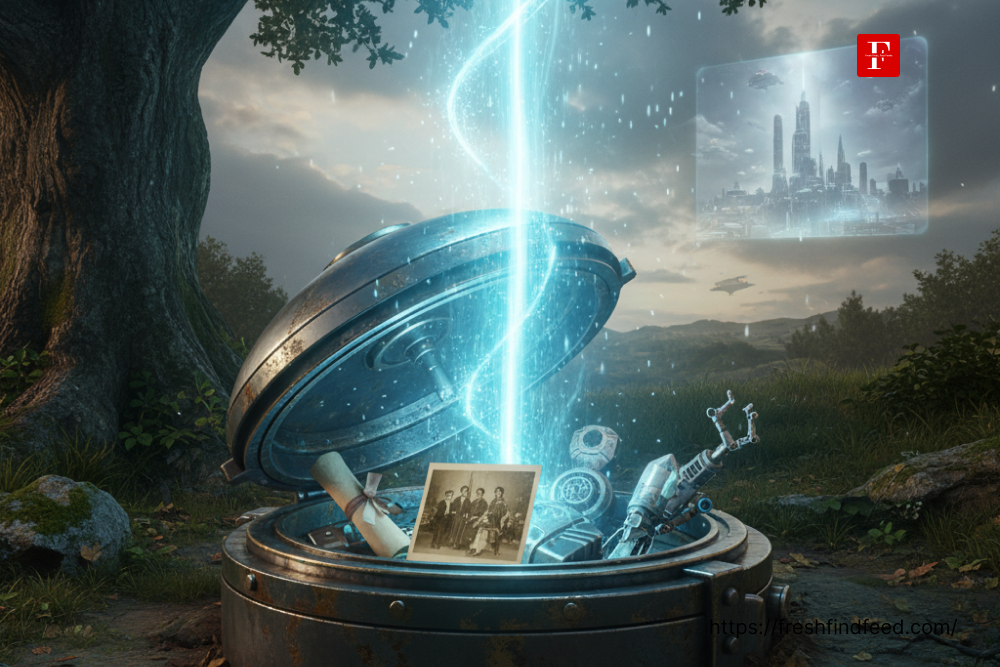
There’s something deeply human about wanting to be remembered. Long before we had social media or cloud storage, societies came up with a different idea: time capsules—containers filled with objects, letters, and artifacts meant to be opened in the future.
They are part history, part prophecy, part human curiosity. But what do these buried messages really tell us about the people who left them behind? And how do they shape the way we think about the future?
The idea of leaving messages for the future isn’t new. Ancient civilizations often built monuments, tombs, and inscriptions meant to outlast them.
Egyptian Pyramids: Filled with treasures, writings, and artifacts—though not labeled as time capsules, they served the same purpose.
Mesopotamian Clay Tablets: Preserved records of laws, myths, and trade.
Medieval Cornerstones: Churches and castles often included sealed boxes with coins and relics, left for future discoverers.
The term time capsule itself became popular only in the 20th century, but the impulse to speak to the future has been with us for millennia.
The 1939 New York World’s Fair popularized the modern time capsule concept. Westinghouse created a sealed container meant to last 5,000 years, filled with everyday items like seeds, a dictionary, and even a pack of cigarettes.
Since then, time capsules have become a global trend:
Schools & Communities: Burying capsules during inaugurations or anniversaries.
Governments: Preserving national identity for future generations.
Corporations: Marketing stunts disguised as “gifts to the future.”
Some capsules are planned with precision; others are forgotten entirely, waiting to be stumbled upon centuries later.
Time capsules often reveal more about human psychology than history itself.
Everyday Objects: Newspapers, coins, toys, fashion items.
Letters & Predictions: People write what they hope or fear about the future.
Technology Snapshots: Old gadgets like floppy disks, radios, or phones.
Cultural Symbols: Music records, art, religious texts.
The choices reflect both pride and anxiety—what people want the future to know about them, and what they hope the future still values.
The Crypt of Civilization (1936, Atlanta, USA): Sealed until the year 8113, it includes recordings, microfilm, and even a plastic Donald Duck toy.
Keio University Time Capsule (Japan): Buried in 1964 with items from Tokyo’s Olympic Games, set to be opened in 2064.
Millennium Vaults (UK): Capsules filled in the year 2000 with music, fashion, and everyday British culture.
Voyager Golden Record (1977): Perhaps the most ambitious “time capsule,” sent into space with sounds, music, and greetings from Earth, intended for extraterrestrials.
Beyond curiosity, time capsules serve deeper purposes:
Immortality: A way for ordinary people to “live forever” through artifacts.
Connection: They create a bridge between generations.
Hope: Many capsules carry optimistic visions of peace, progress, and prosperity.
Warning: Some are meant as cautions—like nuclear waste burial sites that include warnings to future civilizations.
Time capsules are less about the future and more about the present—they are mirrors of a society’s values at the time of burial.
Ironically, many capsules never reach their intended audience. They are misplaced, destroyed, or opened too soon. Some are buried with no records, meaning they may never be found.
This highlights the paradox of time capsules: they are both fragile and eternal, both a promise to the future and a gamble against time itself.
In today’s world, the concept has evolved. Now we have digital capsules:
Cloud-based services where people write letters to their future selves.
Blockchain vaults designed to store data for centuries.
Social media “memory” features acting like micro-capsules.
But this raises new questions: Will our data survive technological obsolescence? Will future generations even know how to access it? A floppy disk in 2025 is already a mystery object—imagine a USB stick in the year 2500.
Time capsules force us to ask profound questions:
What do we want the future to remember about us?
How do we balance honesty with pride?
Are we speaking to future humans—or to an unknowable world we cannot imagine?
Perhaps the true value of a time capsule isn’t in what the future learns, but in how the present reflects on itself during the act of creation.
Time capsules are not just boxes of artifacts. They are acts of hope, anxiety, and storytelling. They reveal a deep truth: humans are not content to simply exist in their moment—we want to echo into the future.
Whether buried in the ground, sealed in a vault, or sent drifting into the stars, every time capsule whispers the same message: “We were here. We mattered. Remember us.”

In today’s world of endless choices and digital noise, marketing is no longer just about promoting products — it’s about creating meaningful connections. Successful brands focus on building relationships rather than chasing transactions. Marketing that connects transforms audiences into loyal communities by earning their trust, understanding their needs, and delivering genuine value. When businesses prioritize people over promotions, marketing becomes more than strategy — it becomes a relationship built to last.

Odisha’s small businesses are entering a new era — where mobile apps, online payments, and e-commerce aren’t luxuries, but lifelines for growth and survival.

As India enters the second phase of its digital revolution, artificial intelligence and automation are not just transforming industries—they’re redefining what it means to work, earn, and adapt.

The conference brought together officials from ten central districts, including district collectors, tehsildars, registrars, and welfare officers, either virtually or in person.

We glorified sleepless nights, burnout, and exhaustion as signs of ambition. But when did working yourself to the edge become the definition of success?

Not everyone who thrives in tech writes code. Some design the very experiences that make technology human.








Leave Comments