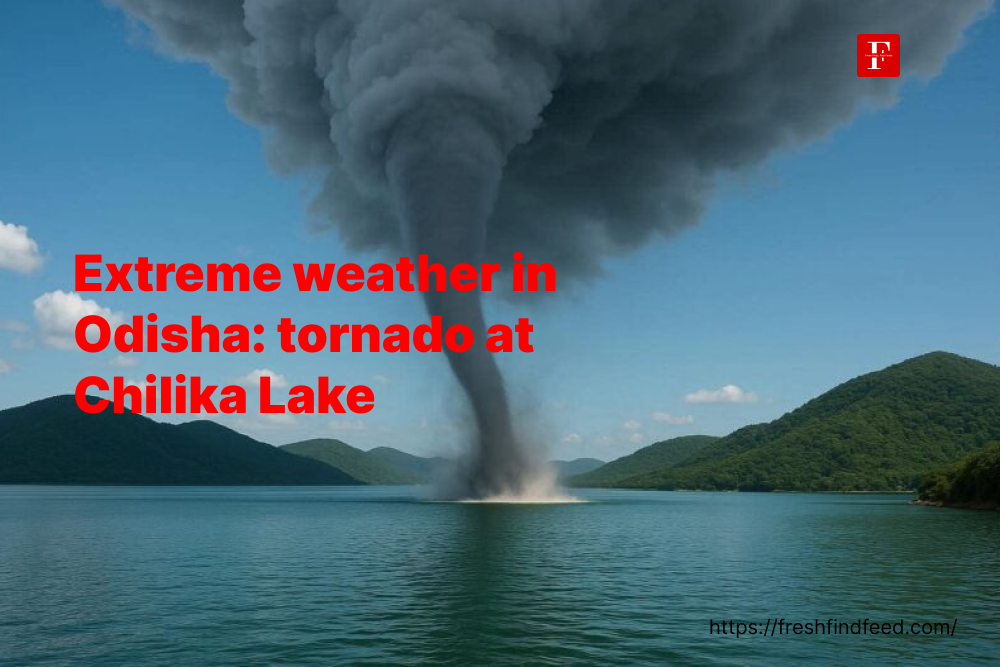
In a rare and startling event, a tornado-like phenomenon was witnessed over Chilika Lake in Odisha, leaving residents and environmentalists alarmed. Videos circulating on social media showed a rotating column of air and spray over the lake’s surface, resembling a small tornado or waterspout. Though brief, the event underscores the growing pattern of extreme weather incidents linked to climate change along India’s eastern coast.
The Rare Whirlwind Over Chilika
The spectacle occurred near the Satapada region, one of Chilika’s most popular tourism zones. Fishermen and boat operators were among the first to notice the funnel-shaped cloud extending from the sky to the lake’s surface. The phenomenon reportedly lasted a few minutes, stirring up water and debris but causing no injuries or property damage.
Meteorologists later identified it as a waterspout, a tornado-like vortex that forms over water bodies when warm, moist air rises and collides with cooler upper layers. Such occurrences are more common in tropical coastal regions, but are rarely documented in Odisha.
What Caused It?
Experts from the India Meteorological Department (IMD) attribute the formation to unstable atmospheric conditions — a sudden build-up of heat and humidity followed by vertical wind shear (differences in wind speed and direction). Combined with Chilika’s unique geography — a mix of saline and freshwater ecosystems — it created a perfect setup for a transient vortex.
According to IMD Bhubaneswar scientist Dr. R. K. Behera, “These waterspouts are usually short-lived but can signal changing climate patterns. The Bay of Bengal has seen an increase in convective storms and erratic temperature gradients over the past decade.”
A Warning from Nature
Chilika Lake, Asia’s largest brackish water lagoon and a UNESCO-recognized wetland, is home to hundreds of migratory bird species, dolphins, and fragile aquatic ecosystems. Experts fear that such extreme weather events could disrupt ecological balance, affecting both wildlife and the livelihoods of thousands of fisherfolk who depend on the lake.
Environmental researcher Ananya Mohanty warns, “We must view this as more than a weather anomaly. Rising surface temperatures, irregular monsoons, and extreme events are clear indicators of climate stress. Chilika’s ecosystem is already under pressure from salinity shifts and pollution.”
Odisha’s Growing Climate Vulnerability
Odisha has faced frequent cyclones, flash floods, and heatwaves in recent years, becoming one of India’s most climate-vulnerable states. From Cyclone Fani in 2019 to Yaas and Amphan later, the coastline has seen repeated battering. The tornado at Chilika adds another reminder that climate volatility is intensifying.
The state government has been expanding its Early Warning Dissemination Systems (EWDS) and disaster preparedness programs, which have saved countless lives during past storms. Yet experts say long-term adaptation—such as coastal vegetation restoration, improved drainage, and community training—is equally vital.
The Science of Small Tornadoes
While large-scale tornadoes like those seen in North America are rare in India, waterspouts and micro-tornadoes can occur along the eastern and western coasts, especially during pre-monsoon and post-monsoon seasons. These are typically less destructive but still dangerous for boats, low-lying infrastructure, and biodiversity.
Satellite data indicates that localized atmospheric turbulence over coastal Odisha has risen by nearly 25% over the last decade—a trend scientists attribute to warming sea-surface temperatures in the Bay of Bengal.
A Call for Climate-Conscious Action
The tornado at Chilika may have caused no damage this time, but it serves as a climatic warning. Odisha’s wetlands, deltas, and coastal towns need stronger environmental monitoring systems and public awareness initiatives. Conservationists are urging the government to integrate climate adaptation measures into ongoing projects like the Odisha Wetland Mission and Blue Economy initiatives.
Chilika, often described as Odisha’s ecological heart, must now also become a symbol of climate resilience—balancing development, tourism, and conservation amid an era of unpredictable weather.