






Supreme Court Accepts Centre’s 100-Metre Aravalli Protection Rule Despite Panel Objections
The Supreme Court has accepted the Union government’s decision to enforce a 100-metre protection rule for areas falling within the Aravalli range, even though a court-appointed expert panel had earlier opposed the move. The ruling marks a significant development in the long-running debate over environmental safeguards and land use in one of India’s oldest mountain ecosystems.
The Centre had argued that a uniform 100-metre buffer from the notified Aravalli boundary would provide clarity for states while balancing environmental protection with development needs. Accepting this position, the apex court observed that the government’s framework offered a workable regulatory mechanism, especially in regions where the Aravalli landscape overlaps with urban and semi-urban zones.
However, the decision stands in contrast to the recommendations of the Supreme Court’s own expert committee, which had cautioned against restricting protection to a fixed distance. The panel had stressed that the ecological spread of the Aravallis cannot be determined solely by administrative boundaries or linear measurements and had called for a broader, landscape-based conservation approach.
Environmental activists have expressed concern that limiting protection to 100 metres could open up large portions of the fragile hill range to construction, mining, and real estate activity. They argue that the Aravallis play a critical role in groundwater recharge, air quality regulation, and biodiversity conservation across parts of Rajasthan, Haryana, and the National Capital Region.
The court’s acceptance of the government’s rule is expected to influence future policy decisions and state-level regulations related to land use in the Aravalli region. While the ruling brings regulatory certainty, the broader debate over balancing development and environmental preservation in ecologically sensitive areas is likely to continue.
Legal experts note that the ruling may reshape how ecologically sensitive zones are defined and regulated across the country. By endorsing a fixed buffer distance, the Supreme Court has signalled greater reliance on government-drawn boundaries rather than dynamic ecological assessments, a shift that could influence future environmental litigation.
The Aravalli range, which stretches across Gujarat, Rajasthan, Haryana, and Delhi, has long been under pressure from illegal mining, deforestation, and unplanned urban expansion. Previous court interventions had imposed stricter controls in parts of the region, particularly in Haryana and the National Capital Region, to curb environmental degradation.
During the hearings, the Centre maintained that inconsistent interpretations of the Aravalli boundary had created uncertainty for both regulators and landowners. The 100-metre rule, it argued, would help prevent arbitrary enforcement while still ensuring a minimum level of environmental protection.
Critics, however, warn that ecological damage does not stop at an artificial buffer line. Conservation groups fear that activities just beyond the 100-metre limit could still disrupt wildlife corridors, affect groundwater flows, and worsen air pollution in nearby urban centres.
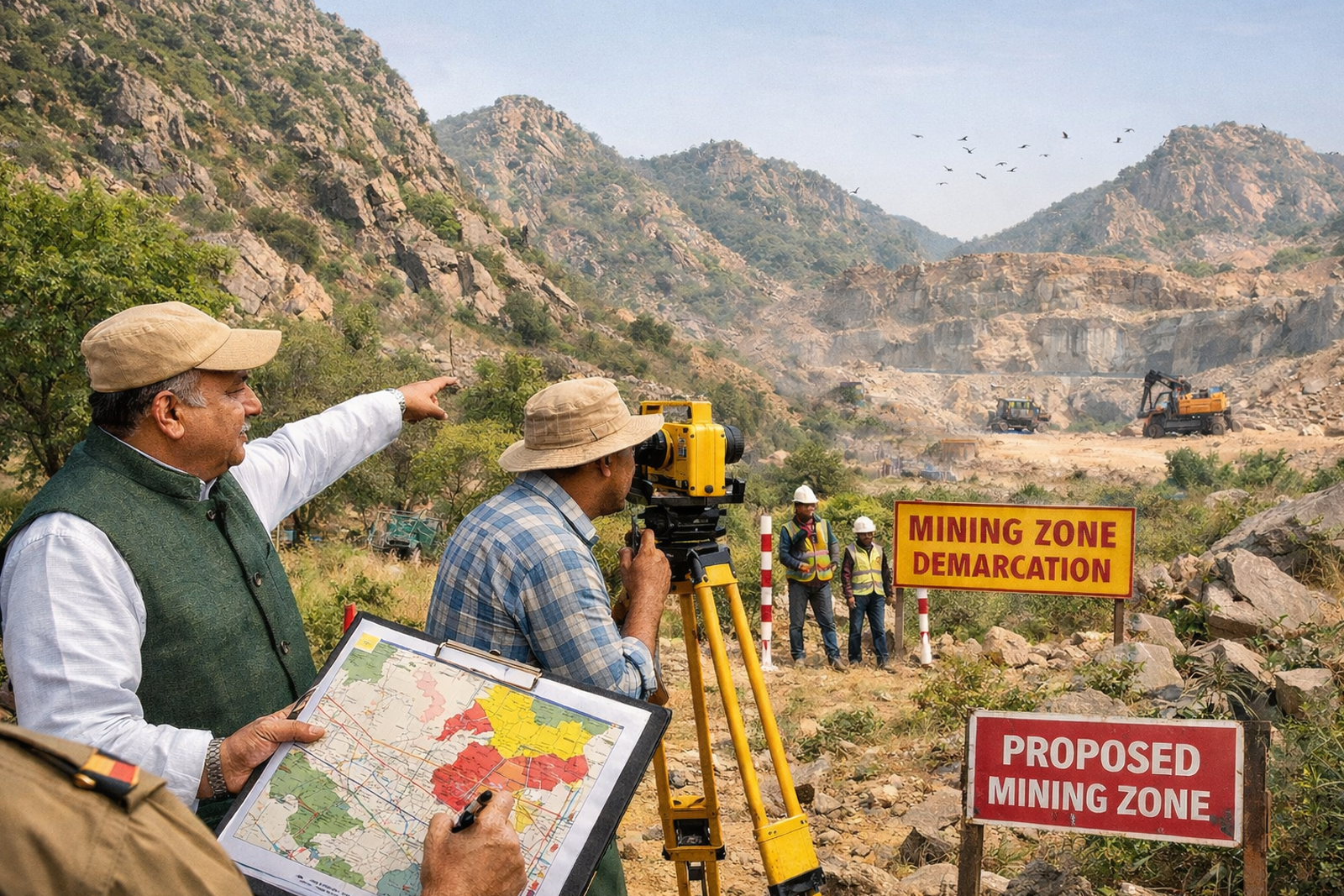
State governments are now expected to align their policies with the Supreme Court’s decision. Officials said updated guidelines and demarcation exercises may follow to identify areas where construction, mining, and commercial activity will be regulated under the revised framework.
As the Aravalli debate continues, the ruling highlights the ongoing challenge faced by policymakers and courts alike — balancing environmental conservation with economic growth in regions experiencing rapid urbanisation.

About The Author
Soojin Das is a dedicated journalist with a strong focus on public affairs, governance, and grassroots reporting. With a passion for uncovering stories that matter, she brings clarity, accuracy, and depth to complex issues shaping communities across India. Her reporting spans politics, social development, education, and local civic concerns, giving readers a balanced and well-researched perspective. Known for her sharp news sense and ethical approach to journalism, Anita combines on-ground reporting with data-driven analysis and compelling storytelling. She has covered major policy announcements, elections, disaster response efforts, and community-led initiatives, ensuring that audiences receive timely and trustworthy information. Anita believes journalism plays a vital role in strengthening democracy and amplifying under-represented voices. Through interviews, investigative pieces, and human-interest stories, she aims to inform, engage, and empower readers. When not in the field, she closely follows media innovation and digital storytelling trends, continually refining her craft to meet the evolving needs of modern newsrooms.
Soojin Das | Journalist


You Might Also Like
-
The Union Environment Minister on Tuesday said that the government is working on a district-wise plan to clearly demarcate mining areas in the Arav...
-
Delhi and its surrounding National Capital Region (NCR) have been placed under strict pollution-control measures after air quality levels plunged i...
Suggested Video